In part 1 I introduced the idea of using elo to rate drivers statistically and determine which was the best of all time.
Greatest Elos of all time
The results of the elo analysis are in and it quickly becomes obvious that they should be taken with a grain of salt. Let’s start with the greatest 10 drivers of all time:
| Rank | Driver | Max Elo | Notes |
|---|---|---|---|
| 1 | Lewis Hamilton | 1,339 | Okay, I’ll buy it |
| 2 | Max Verstappen | 1,260 | Sure, makes sense |
| 3 | Michael Schumacher | 1,217 | Still looking good |
| 4 | Nico Rosberg | 1,206 | Really? |
| 5 | Sebastian Vettel | 1,205 | Boy, I would have thought 4 drivers’ championships would have gone further… |
| 6 | Valtteri Bottas | 1,184 | Really like the guy, would not rate him over Senna. Mercedes effect |
| 7 | Fernando Alonso | 1,155 | Fast at Renault and Ferrari |
| 8 | Ayrton Senna | 1,143 | Elo peaked earlier than I expected |
| 9 | Alain Prost | 1,142 | Guess that settles that debate |
| 10 | Sergio Perez | 1,122 | Red Bull Effect |
What stands out? Lewis Hamilton as the GOAT; hard to argue he is far from it. Schumacher at third; sure. Nico Rosberg at fourth though; I am willing to buy that he is underrated but I wouldn’t expect him to be rated higher than Senna, Prost, or Alonso.
So what is going on? As mentioned in the previous article car and team dynamics show up in the drivers’ results as they are the units facing off against each other. The chart below effectively shows that the best drivers in the world have their butts in the best cars in the world. In F1, drivers may face off on the track, but as the rankings shows, it’s often the car that makes a huge difference in results.
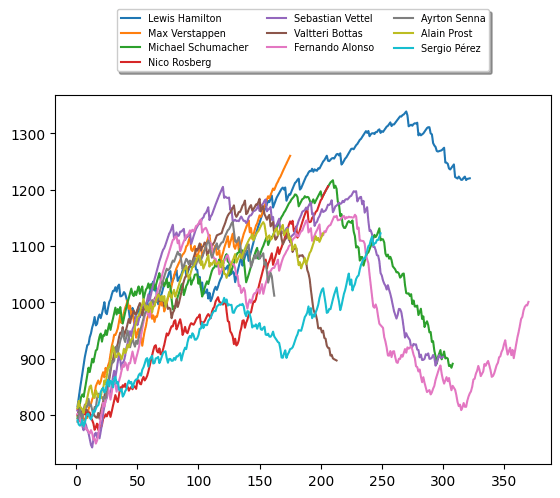
This begs the question of how to control for car effect in F1. More on that below, but first let’s play with the output of the tool a bit more starting with the drivers at the other end of the spectrum.
Lowest elo rating of all time
So who has the infamous distinction of having the lowest Elo rating? Arturo Merzario holds that infamous title. He entered 85 grands prix, but failed to qualify in 26 of them and did not start in 2 others. To be totally fair, he set up his own team towards the end of his career and this is where most of the DNQs come from. Earlier in his career he raced with Shadow, the team run by a possible former CIA operative which got its start in Can-Am and scored 7 podiums and 1 victory in F1 in the 70s.
That said, Niki Lauda credits Merzario with saving his life at his crash during the ’76 German Grand Prix when he pulled Lauda to safety from his burning car. Lauda gifted him his Rolex for doing so, but unfortunately that act of heroism does not impact his Elo.
The greatest upsets of all time
Underdogs, cinderellas, upsets – we all love rooting for them; what are some of the biggest?
The largest change in Elo in a single race
The year: 1990. The track: Suzuka. An upstart Adrian Newey had recently been fired from his first technical director role at Leyton House Racing; he would land on his feet, but that’s not the story today. No, that honor goes to Roberto Moreno who up to this had failed to even qualify his Eurobrun in 11 of the preceding 14 races that year and the only race he had finished this season was in 13th. Moreno then got a seat for the remainder of the season in a Benneton and finished second after Senna and Prost collided, sealing the championship for Senna, and Nigel Mansell retired from the lead. This would be his best finish in the Benneton until he was replaced by plucky young rookie name Michael Schumacher.
The driver with the lowest Elo going into a race they won
This honor goes to Pastor Maldonado at the 2012 Spanish Grand Prix. Driving for Williams that year over half of his points came from this victory and he was legitimately fast all weekend, taking second in qualifying and being promoted to pole after Lewis Hamilton’s car did not have enough fuel for scrutineering.
Maldonado would finish the season 15th in the driver’s standing. This was the first win for Williams since Juan Pablo Montoya delivered one in the 2004 Brazilian Grand Prix. They have not won since.
What’s Next
It’s clear that car performance is a huge factor as the examples above are skewed by it; with the exception of Maldonado’s win.
To better understand the car effect, I’ll focus on comparing teammates over time. Teammates drive the same car, so analyzing how they perform against each other can reveal individual skill more clearly. The challenge will be in determining the teammate’s strength outside of the comparison, ideally using other results.
 Deliberately Hacky